Our Roots at Fort Chiswell
The Fort Chiswell Chapter takes its name from one of the most significant sites in Virginia's Revolutionary War history.
The Fort
Fort Chiswell was established circa 1758–1760 as a military outpost during the French and Indian War by Colonel William Byrd III. The fort was named for Colonel John Chiswell, who discovered rich lead deposits in the area in the 1750s. Situated at the junction of the Great Trading Path and the Richmond Road in what is now Wythe County, Virginia, it became a vital supply point for the frontier.
The Lead Mines
About seven miles south of the fort, near the New River at present-day Austinville, Chiswell and his partners established lead mines that would prove critical to the American Revolution. In July 1776, Thomas Jefferson wrote to Governor Patrick Henry describing the mines as “inestimable” and “perhaps the sole means of supporting the American cause.” By October of that year, mine managers had ten tons of lead ready for the Continental Army. As late as 1782, General Nathanael Greene ordered lead from the mines for a munitions factory in North Carolina.
“Considered as perhaps the sole means of supporting the American cause, they are inestimable.”
The Fincastle Resolutions
On January 20, 1775 — more than a year before the Declaration of Independence — fifteen elected representatives of Fincastle County gathered in what is now Wythe County, probably at James McGavock’s tavern in the Fort Chiswell settlement, and adopted what became known as the Fincastle Resolutions. These were the first adopted statements by American colonists which promised resistance to the death to the British crown to preserve political liberties.
Isaac Shelby, who became the first governor of Kentucky
“These are our real though unpolished sentiments of liberty and loyalty, and in them we are resolved to live and die.”
The Monument
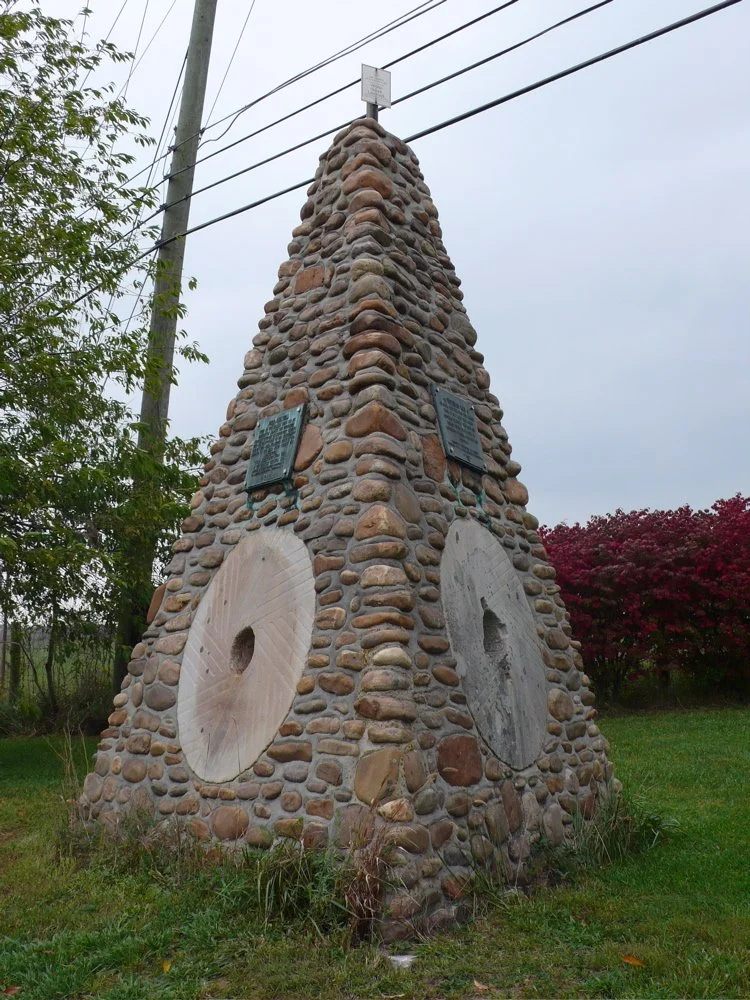
Today, a pyramid-shaped sandstone monument — incorporating millstones from the old Fort Chiswell Mill — marks the approximate location of the original fort. The remaining foundations were covered during construction of I-77 in the 1970s, but salvage excavations in 1976 by the Virginia Department of Historic Resources recovered prehistoric remains and remnants of three successive periods of 18th-century occupation.
The Fort Chiswell Site was listed on the National Register of Historic Places on August 29, 1978. The Mansion at Fort Chiswell, built in 1839–1840 by Stephen and Joseph Cloyd McGavock, and the McGavock Family Cemetery are also on the National Register — three related listings that together tell the story of this settlement from frontier outpost to prosperous plantation.
Our Preservation Work
The Fort Chiswell Chapter continues this legacy of preserving our Revolutionary heritage. In 2009, the chapter sponsored a historical marker in Bristol honoring Colonel Isaac Shelby — hero of the Battle of Kings Mountain and first governor of Kentucky — whose family settled near Bristol around 1770. The chapter also supports the Bristol Historical Association’s restoration of the Robert Preston House, a Federal-era home dating to approximately 1790.